Sunday, April 24, 2011

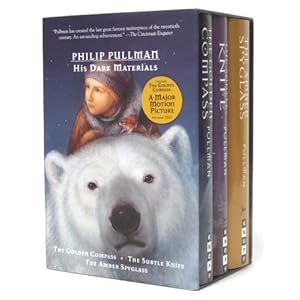
The Golden Compass

His Dark Materials Trilogy (The Golden Compass; The Subtle Knife; The Amber Spyglass)

Lyra, a precocious, yet innocent girl, is frantically searching for her best friend, Roger.  His disappearance sets the story in motion, but is really only the flour in this bread recipe.  Lyra along with her daemon (a physical representation of one’s soul) sets out on a great journey to find him, but discovers far more than she ever dreamed of.

This is not your typical coming of age story though; it deals with far deeper and more adult themes such as the forming of one’s soul and identity, the creation of the world, the sustaining of the world, religion vs. government, developing relationships and trust of others, and of course, good vs. evil and all of the gray in between.  The world in which the story takes place is fictional.  While it contains all of the themes we are familiar with, having the soul as a separate entity from the body is new and foreign.

It is a complicated and twisted plot that I will not disclose for those who have not read it yet.  What would you expect from a story based on Herman Melville’s “A Paradise Lost”? But it’s the butter on top of the bread that kept me reading:

“The evening sky was awash with peach, apricot, cream: tender little ice-cream clouds in a wide orange sky” (p. 62).

Ah, a moment of clarity amongst the confusion.  Roger is lost, but with a beautiful sky like this, how could one not have hope that he would eventually be found?  This one sentence made me taste a dreamcicle: an orange crunchy exterior with a cool, vanilla creamy inside.  This one sentence was enough to inspire my entire bread and butter theory. The Golden Compass is an absolutely delicious read.

A Bread & Butter Book Theory

If I say a book is “bread & butter,” it’s the highest compliment I can give it.  Bread – yummy bread – whether it’s whole wheat or white, a sandwich, roll, or even a pancake – it’s the foundation, the vehicle for something even more delightful – butter.  What can I say about butter?  Who doesn’t love butter?  It’s salty, it’s sweet, it’s creamy, and it’s heaven to the taste buds.  It doesn’t matter if it is made out of milk, corn oil, or even soy; it’s butter!

Now that we all want bread and butter, back to books!  The story is the bread: the plot, the characters, the dialogue, the foundation.  The butter is the words: the language, the adjectives, the metaphors.  The story provides the reader a reason to keep reading, while the words paint a picture for the reader to not only see the story, but to feel it, to taste the words.

Can a story exist by itself?  Of course.  Can words?  Obviously.  Would you eat a piece of bread by itself?  Sure.  It might be a little dry, but manageable. Would you eat a spoonful of butter by itself though? Probably not – too rich.  It needs the bread – something to soak into, something to pile up on, something that allows it to glide right into your mouth.  The butter of the story is more than just pretty words though; it’s the way those words are strung together.  The true butter of a story is a perfectly constructed sentence that makes you close your eyes and holds your breath, taste the words on your tongue, while a picture materializes behind your eyes.  That’s butter.

A great book or piece of writing has both: bread and butter.  If an author can capture both, I will devour and savor every word until the end and then crave more.  And that is my bread and butter theory on books.