Sunday, April 27, 2014

The Book Thief

"The Book Thief" by Markus Zusak is a beautiful and dark story about human nature.  In my opinion it is a bread and butter book or maybe it is a butter and bread book.  What would you expect from a story told by Death?  It is not your typical story.  Death in this case is quite poetic, telling us the color of the sky and the weight of the souls he carried into it and how that weight grew in the 1940’s throughout Nazi Germany.  He swirls this language on top of a thick, crusty, somewhat stale yet entirely welcome foundation of a bready story of a pre-teen girl named Liesel Meminger. And yet the story itself isn't stale because of Death’s poetic approach.


Through direct foreshadowing, Death lets the reader know what to expect throughout the story’s entirety.  It reminds me of Shakespeare’s “star-crossed lovers,” as the reader knows from the very beginning that its characters will not have a happy ending; however, The Book Thief points out that life itself is a “star-crossed” love story: all of us are dying; it’s just a matter of when and how and perhaps the color of the sky.  No matter how many stories are told about the Titanic, the giant ship still sinks at the end and so it is with Nazi Germany: it still sinks and it pulls many people down with it, not necessarily innocent people – just people.

This book makes us question humanity: what is good, what is evil, and what is true.  The story, the bread of this book makes the reader struggle along with its characters, but it is a struggle well worth the effort.  Its powerful message reminded me of three things:

1.                   Milgram’s social psychology experiment
Three volunteers were involved in the experiment: an experimenter who was the authority figure, a teacher who carried out the experimenter's directions, and a subject who was acting as the test figure. The experimenter commanded the teacher to shock the subject every time the subject (keep in mind the subject was acting and not actually being shocked) got an answer incorrectly. A surprising 65% of teachers used the highest voltage at the experimenter’s command.  Milgram stated that “Ordinary people, simply doing their jobs, and without any particular hostility on their part, can become agents in a terrible destructive process.” (For more information, see http://en.wikipedia.org/wiki/Milgram_experiment.)  I think that statement describes the situation of the characters in The Book Thief perfectly.  “Heil Hitler” was a part of life for them whether or not they believed in what it stood for or not.  It was a means of survival.  I think that the innate desire to survive supersedes all philosophical discussions about the nature of humanity, its need to obey authority, and its inevitable pull between good and evil.

S. Farley’s Ferret
I remember sitting on the floor in Miss McDowell’s 3rd grade class.  This was the first time I had heard the term “Nazi”.  I was wearing a dress and my knees were skinned, yet I sat cross legged on the floor just like the other students.  S. Farley had brought his pet ferret to class that day with permission from the teacher.  It darted around our legs; its fuzzy body pushing against us playfully.  Miss McDowell taught us about the Holocaust and told us how Hitler and the Nazis were trying to create a superior race of people with only blonde hair and blue eyes.  Stephen Farley and I looked directly at each other, our blonde hair unmistakable, our blue eyes questioning if we were somehow better than the tanned faces and dark hair and eyes of the other children in the room.   The question only lasted a split second before all of those other faces turned their stares back and forth between the two of us as if we were responsible for the deaths of the Jewish people in Nazi Germany.  No, we were certainly not better than anyone else.  As I began to feel this weight, which was very heavy on the shoulders of an 8 year old, I felt the fuzzy ferret dart up my dress and rest on my outer thigh.  I’m sure the judgmental and accusatory stares continued, but I chose to focus on the fuzzy ferret and refused to believe that the color of my skin, hair, and eyes made me a monster.  Just as it is wrong for people to persecute those who are different from themselves because of those differences; it is wrong to accuse and assume that those who have the same physical features of monsters also have the same beliefs.  Not all Germans were Nazis and not all Nazis believed in Hitler; they all believed in survival and fought to live.

The Power of the Word
Words are extremely powerful in the labels that we give one another that essentially define our roles in the world: Experimenter, Teacher, Subject, Nazi, Jew, or even Blonde and in the stories of our lives that push us to keep learning from each other and to keep living for each other.  Words have the power to destruct, the power to save, and according to The Book Thief even the power to inspire Death.

Any book that has the ability to push the reader to reflect on  their own beliefs and fully consider its story and its characters is as essential as bread and butter.

Monday, August 19, 2013

The Midnight Dress

 
“The Midnight Dress”  by Karen Foxlee is an amazing story – a bread and butter story that leaves you full, completely satisfied; the taste of salty butter still lingering on your lips and feeling a little sad that you ate all of it.  The book is woven around Rose, a lonely high school girl, who wanders around the country with her alcoholic father.  They come to a small sea side town, which she calls “Paradise” somewhat sarcastically and truthfully at the same time.

Rose is sarcastic; she views herself as dark and above most things without being snobby, yet the view she has of herself is not the view other people or the reader have of her.  “Paradise” has an annual tradition that all of the girls ride in a float in beautiful dresses and the most beautiful and deserving is crowned queen.  Rose meets Pearl and a friendship is born.  Rose tries to push her away and hide behind her “dark” heart, Pearl doesn’t allow it.  Her goodness, her bubbliness, and her nonstop talk overcomes Rose’s standoffishness. She convinces Rose that she must participate in the parade and have a dress made.
Each chapter is named after a type of stich, threading the characters together throughout the entire book.  Rose meets Edie who has the reputation of being the town witch.  Edie agrees to make a dress for Rose if she helps sew it.  The author remarkably weaves a story of intrigue: Edie who is witch to a town and not witch to the reader, Rose who has a ruby heart but sees it as the darkest black, and Pearl who is beautiful to everyone but feels trapped by a small town.

A simple story of friendship?  Not at all. Enter a detective, a murder case, a mysterious mountain, and that lonely feeling that creates a sense of loss, a sense of lost in even the most seemingly well put together people and you have the bread, the foundation of a wonderful story.
As for the butter, the lingering saltiness, the beautiful language threaded and woven into each character’s thoughts, it's creative and poetic, yet to the point. Rose thinks of how Edie must feel about the mountain she has come to love:

“How she must miss it now. How she must long for the singing creeks and the secrets of the trees.  Was that why she collected and kept so much from the place?  All the leaves rotting in boxes and white cedar flowers pressed behind paper.  All the powdery remains of firewheel blossoms and climbing lilies, like dying stars, withering” ( p. 288). 

On one hand there is beautiful imagery of sing creeks, cedar flowers, and firewheel blossoms, and on the other there is the opposite of ugly rotting, remains, and dying.  The author does an excellent job throughout the book of pulling the reading in these two opposite dichotomies for the setting, characters, and overall story. 

This is a must read.


Sunday, April 24, 2011

The Golden Compass

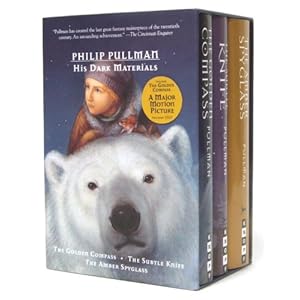
His Dark Materials Trilogy (The Golden Compass; The Subtle Knife; The Amber Spyglass)

Lyra, a precocious, yet innocent girl, is frantically searching for her best friend, Roger.  His disappearance sets the story in motion, but is really only the flour in this bread recipe.  Lyra along with her daemon (a physical representation of one’s soul) sets out on a great journey to find him, but discovers far more than she ever dreamed of.

This is not your typical coming of age story though; it deals with far deeper and more adult themes such as the forming of one’s soul and identity, the creation of the world, the sustaining of the world, religion vs. government, developing relationships and trust of others, and of course, good vs. evil and all of the gray in between.  The world in which the story takes place is fictional.  While it contains all of the themes we are familiar with, having the soul as a separate entity from the body is new and foreign.

It is a complicated and twisted plot that I will not disclose for those who have not read it yet.  What would you expect from a story based on Herman Melville’s “A Paradise Lost”? But it’s the butter on top of the bread that kept me reading:

“The evening sky was awash with peach, apricot, cream: tender little ice-cream clouds in a wide orange sky” (p. 62).

Ah, a moment of clarity amongst the confusion.  Roger is lost, but with a beautiful sky like this, how could one not have hope that he would eventually be found?  This one sentence made me taste a dreamcicle: an orange crunchy exterior with a cool, vanilla creamy inside.  This one sentence was enough to inspire my entire bread and butter theory. The Golden Compass is an absolutely delicious read.

A Bread & Butter Book Theory

If I say a book is “bread & butter,” it’s the highest compliment I can give it.  Bread – yummy bread – whether it’s whole wheat or white, a sandwich, roll, or even a pancake – it’s the foundation, the vehicle for something even more delightful – butter.  What can I say about butter?  Who doesn’t love butter?  It’s salty, it’s sweet, it’s creamy, and it’s heaven to the taste buds.  It doesn’t matter if it is made out of milk, corn oil, or even soy; it’s butter!

Now that we all want bread and butter, back to books!  The story is the bread: the plot, the characters, the dialogue, the foundation.  The butter is the words: the language, the adjectives, the metaphors.  The story provides the reader a reason to keep reading, while the words paint a picture for the reader to not only see the story, but to feel it, to taste the words.

Can a story exist by itself?  Of course.  Can words?  Obviously.  Would you eat a piece of bread by itself?  Sure.  It might be a little dry, but manageable. Would you eat a spoonful of butter by itself though? Probably not – too rich.  It needs the bread – something to soak into, something to pile up on, something that allows it to glide right into your mouth.  The butter of the story is more than just pretty words though; it’s the way those words are strung together.  The true butter of a story is a perfectly constructed sentence that makes you close your eyes and holds your breath, taste the words on your tongue, while a picture materializes behind your eyes.  That’s butter.

A great book or piece of writing has both: bread and butter.  If an author can capture both, I will devour and savor every word until the end and then crave more.  And that is my bread and butter theory on books.